While the internet makes it easy to create and share your own work and be inspired by the work of others, some people make their living from original works. Copyright law allows them to protect their work. On the other hand, there are others who like to create, share and remix on the open web. To let others know that their work is available for re-use (in the way that they specify), open licenses were created (called Creative Commons Licenses).
Openly licensed content, sometimes called Open Educational Resources or OER’s have an open copyright license that allows users to copy the resources and to engage in the “5Rs” open content: Retain, Reuse, Revise, Remix, and Redistribute. What does this all mean for you as a student?
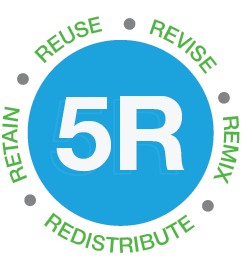
Materials created by David Wiley, CC by 4.0
The 5R’s
The 5R’s of open content gives students and other users the following rights:
Retain
The right to make, own, and control copies of the content:
- Unlike conventional textbooks, OERs are free to access and download for your own use.
- Unlike online textbooks and course materials that require an expensive access code and expire after your course is done, you can keep your own copy of OERs and continue to use it after the term is over.
- By adding an open license to your work, you retain your rights as content creator AND you make it east for others to build on your work.
Reuse
The right to use the content in a wide range of ways (e.g., in a class, in a study group, on a website, in a video):
- Professors can more easily share course content with you.
- You are free to use OERs in class projects and presentations, such as using openly licensed images on research posters or presentation slides, without breaking copyright laws. Of course, you always acknowledge the source.
Revise
The right to adapt, adjust, modify, or alter the content itself (e.g., translate the content into another language):
- Because anyone can edit OERs, you can build on the work of scholars and other students by editing or adding to their openly licensed work – in a revision – the original context and meaning is maintained. Of course, you always acknowledge the original source.
- Professors can create course assignments that have you build on the work of others, allowing you to participate more fully in scholarly discourse. See UBC’s Latin American Literature and Linguistics as examples of students collaborating with community experts to author and revise original work.
- Mediawiki (the platform the runs Wikipedia and the UBCWiki) supports this principle of open by allowing for revision, documenting revision history, allowing for version control (you can revert to an original after revision of you want) and associating users with revision history – so you can keep track of who has edited the work. More about wikis for learning.
Remix
The right to combine the original or revised content with other open content to create something new (e.g., incorporate the content into a mashup):
- remixing content allows you to combine resources in different ways which may vary widely from the original context of the work. A common example of mashups include memes, combining open data to create virtual tours, etc.
- Making a Mashup Friendly Library offers some excellent examples of how libraries can support mashups which lead to really useful community resources. It is an open resource created by a graduate student in Library School at UBC.
Redistribute
The right to share copies of the original content, your revisions, or your remixes with others (e.g., give a copy of the content to a friend):
- Rather than turning in assignments to one person, your professor, and never seeing it again, your openly licensed work can be shared with a wider audience of learners who can learn from and build upon it themselves. See examples of open courses and resources at UBC and beyond.
For more info about the 5R’s, see defining open content David Wiley’s article Defining the “Open” in Open Content and Open Educational Resources.
Creative Commons Licenses
Students, Professors, Artists, and other Creators who wish to have the 5R’s embedded in their work most often do so by using a Creative Commons License. Creative Commons is a non-profit organization whose mandate is to make it easier for creators to share their work and/or build upon the works of others consistent with the rules of copyright. They have created standard, easy to use and understand copyright licenses that anybody can apply to their work to allow others to share, remix, or use the work without having to contact the copyright owner to ask for permission. There are several Creative Commons licenses, each with a different level of use restrictions.
Open Licensing for Students
|
You can turn your assignments, essays, and other academic work into an open education resources. Here’s how:
- Consider applying a Creative Commons license to your work – it makes it more shareable: Marking Your Work With a CC License
- Make it easy to download or (better yet) take apart for remixing. Note: on YouTube, you can license your work with a Creative Commons License and others can remix it in the YouTube video editor.
- Publish it on a blog or wiki or in an open journal like the ones listed in the previous section.
- If you take photos or create images, especially if you do so in the course of your studies, consider uploading them to a platform like flickr that allows you to license them openly. Here is Foter’s handy guide/infographic for creating and using CC licensed images.
Creating and publishing to YouTube? You can also select a CC license for any video you upload to YouTube. This will allow others to find and build on your work or access it for remixing using YouTube’s video editor.
- More about CC licenses on YouTube.
- Adjusting licensing and permissions on YouTube – how-to with screen shots from Jorum.
Learn more from our handy guide: Open Licensing for Students.
Publishing Your Work
Publishing and sharing is a key part of scholarship and academic life and there are many options for students to publish their work and their are many options for publishing.
Personal Publishing
- Create a blog that you can use for posting and sharing your work. You can select the work you want to share openly and even use your blog for class contributions where student blogging is a requirement.
- Get a blog.
- Learn how to do things on a blog.
- Comments and Privacy: You can control which posts or pages you make public and even choose which users can see what by choosing the options that you want on the blog’s privacy settings. Comments allow you to engage with your audience by responding to questions and comments on your posts. It offers the potential of getting feedback on your work and your ideas from a wider range of people than just your classmates and instructors- if that’s what you choose.
Open Journals
There are also many opportunities to publish your research in undergraduate journals right here at UBC. UBC Library’s institutional repository, cIRcle, is an open access repository that contains a number of items from undergraduate students. To date, there are 1,700+ undergraduate items in cIRcle/OC from across various faculties, departments, schools and centres, etc. as well as conferences and through community partner initiatives.
Additionally, check out the R2RC Open Publishing Guide for Students.
“Launched as SPARC’s student initiative in 2009, the Right to Research Coalition (R2RC) is an international alliance of undergraduate and graduate student organizations, which collectively represent nearly 7 million students in over 100 countries, that work to promote Open Access to research through advocacy and education. R2RC members work to educate the next generation of researchers, administrators, and policy makers about the benefits of Open Access and to advocate for policies at the local, national, and international level that require the results of research to be made freely available online with full reuse rights. The coalition also seeks to make students a full partner in establishing Open Access as the default for scholarly communication. – See more at: http://www.sparc.arl.org/initiatives/r2rc#sthash.B3kHryFi.dpuf”
Here are some examples of currently active open access journals that are student-led:
- BC Pharmaceutical Sciences Student Journal
- Atlas Undergraduate journal of World History
- NGDI (Neglected Global Diseases Initiative) Student Global HealthJournal
- The Seed: the Undergraduate Journal of Canadian Studies
- hemlock
- The Talon “UBC’s Alternative Student Press”
Digital Tattoo Publishing ResourcesThe Digital Tattoo Project has created in-depth guides to publishing and making your own work available online: |
